Mass-EXPERT mass flow meters for measuring and dosing a wide range of food products and beverages — from liquid dairy products to highly viscous chocolate masses and pastes. Hygienic design with roughness Ra ≤ 0.8 µm, sanitary Tri-clamp connections and full CIP/SIP cleaning without disassembly ensure compliance with the strictest food safety standards.
Mass-EXPERT Coriolis flow meters in hygienic design handle a wide range of food media — from low-viscosity juices to highly viscous chocolate masses and pastes.
Glazes, chocolate mass, cocoa butter, fillings, pralines, nut pastes. High viscosity calls for straight-tube L-type or W-type sensors without dead zones.
Glucose, fructose and invert syrups, molasses, honey, maple syrup. High density and viscosity do not affect mass measurement accuracy.
Tomato paste, ketchup, mayonnaise, mustard, soy sauce, vegetable pastes. The straight-tube design prevents clogging and simplifies CIP cleaning.
Milk, cream, condensed milk, yoghurt, kefir, whey, ice cream. Coriolis flow meters are the standard for milk intake metering.
Fruit and vegetable juices, concentrates, nectars, soft drinks and low-alcohol beverages. Brix and density measurement in a single device.
Ethanol/food-grade alcohol, liqueurs, tinctures, plant extracts, flavourings. Direct mass flow measurement unaffected by density.
Vegetable oils (sunflower, olive, palm), animal fats, margarine. Mass flow measurement from cold to hot.
Filling, blending, filtration and tank-to-tank transfer. Product density and extract content do not affect mass measurement accuracy — precise filling accounting and control of losses and rinses between batches.
Mass-EXPERT flow meters in hygienic design meet the stringent requirements of the food industry and ensure product safety and ease of sanitation. For Russia, Expert Conclusion No. 299 on compliance with the Common Requirements of the Customs Union is available.
Unlike many conventional flow meters, Mass-EXPERT Coriolis sensors in hygienic design do not require disassembly for sanitation. Straight-tube L-type and W-type sensors with Ra ≤ 0.8 µm roughness withstand CIP cleaning (hot water / alkaline and acid solutions at flow velocities up to 1.5 m/s) and SIP sterilisation (with saturated steam at temperatures up to 140 °C). This radically reduces changeover time between batches and eliminates the risk of recontamination during maintenance.
Coriolis direct mass measurement technology — the optimal solution for hygienic metering and dosing of food products
Contact surface roughness Ra ≤ 0.8 µm. Tri-clamp sanitary connections. 3-A compliance. No dead zones.
Cleaning and sterilisation without sensor disassembly. Withstands CIP temperatures up to 140 °C and flow velocities up to 1.5 m/s.
W-type with full-drain configuration. Product changeovers without flushing — ideal for multi-product production.
Independence from viscosity, density, temperature and flow profile. Ideal for viscous pastes, chocolate, honey and syrups.
Simultaneous mass flow and density measurement. Concentration (Brix) calculation for juices, syrups and spirits.
No moving parts and no seals to replace. Lower operating costs and reduced maintenance downtime.
For particularly viscous food products — tomato paste, chocolate, honey, nut pastes — Mass-EXPERT offers L-type (straight-tube) sensors. The absence of bends in the measuring tubes eliminates dead zones and minimises hydraulic resistance. Combined with Ra ≤ 0.8 µm and Tri-clamp connections, this is the best solution for food production with high hygiene requirements.
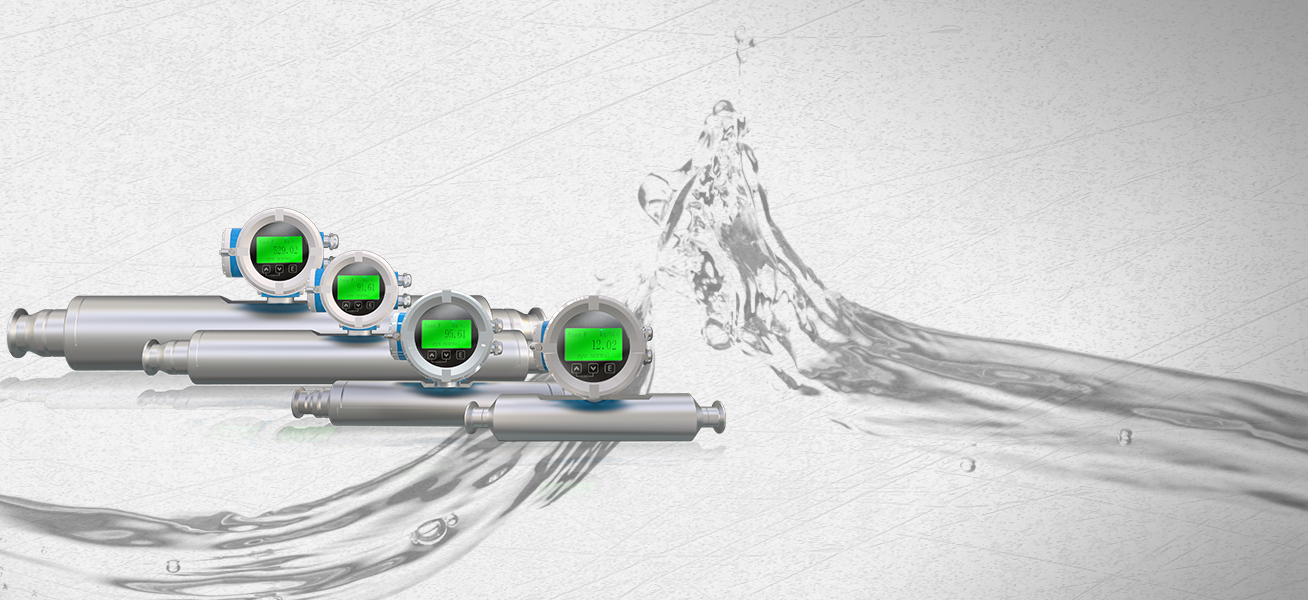
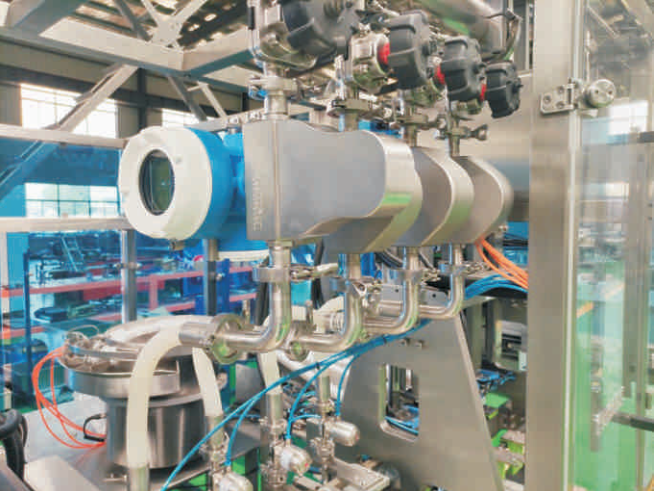
Proven combinations of sensors, connection types and options for typical food and beverage production tasks
Recommended for viscous and pasty food products. The absence of bends eliminates dead zones and simplifies CIP/SIP cleaning.
Tri-clamp sanitary connections (DIN 32676 / ISO 2852) and Ra ≤ 0.8 µm roughness — compliance with strict food safety standards.
Special measuring chamber configuration for complete product drainage. Ideal for product changes without intermediate flushing.
Transmitter selection depending on digital interface, explosion protection and functionality requirements.
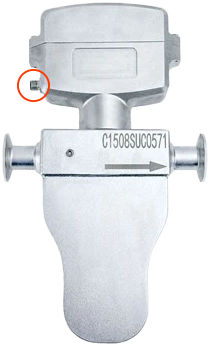
For compact food lines, Mass-EXPERT offers the ME400 transmitter in a stainless steel housing: its proprietary quick-release power and signal connector allows the device to be connected and removed in seconds — during product loading/unloading and sanitation. No display and no explosion protection — minimal dimensions and a smooth surface without crevices where product could accumulate. Power supply: 24 V DC, interfaces: RS-485 (Modbus RTU) and a pulse output for integration into the APCS.
For highly viscous products (tomato paste, chocolate, honey): L-type sensor
+ Tri-clamp + Ra ≤ 0.8 µm + ME200 / ME400 transmitter.
For liquid products with frequent changeovers (juices, syrups, milk): W-type sensor
(self-draining) + Tri-clamp + ME100 / ME400 transmitter.
For metering spirits and extracts: L-type or U-type sensor + 316L +
ME200 transmitter with HART/Modbus.
For super-compact installations — the ME400 is used: stainless steel housing,
quick-release connector, smooth crevice-free surface, RS-485 (Modbus RTU) and pulse output.
Answers to the questions most often asked about this application.
The sensor's measuring tubes vibrate, and the product flowing through them produces Coriolis forces. This makes the oscillation phases at the inlet and outlet shift apart, and the shift is directly proportional to mass flow. The meter calculates kilograms straight away — no recalculation via density or temperature.
From milk intake to beverage filling: metering and dosing of dairy products, chocolate masses, syrups, sauces, juices, spirits and oils; blending and filtration in brewing; loss and wash-out control between grades. The media breakdown is in the table on this page.
Brix and temperature come from the same sensor: density is measured alongside mass, and for juices and syrups the concentration is derived from it. The density range spans 650–2000 kg/m³, and all three values are available simultaneously.
A Coriolis meter measures mass directly, in kilograms, while volumetric meters give litres and need density conversion. For recipes, dosing and product accounting this removes extra links: no correctors and no viscosity corrections are required.
The main limitation is free gas in the stream: aerated products reduce liquid measurement accuracy. At large line sizes the meter costs more than volumetric options, and high pressures require a special execution; flow parameters are assessed from your datasheet.
Chocolate mass, glaze, cocoa butter, praline and nut pastes are measured with L-type sensors: straight tubes without bends have no stagnant zones and do not clog. Product viscosity does not affect accuracy — mass is measured directly.
Milk intake is a typical duty for these meters; we also measure cream, condensed milk, yoghurt, kefir and whey during transfers and recipe dosing. Lines with frequent product changes are fitted with a self-draining design.
Thick sweet media are routine: high viscosity and density do not affect mass flow. For glucose, fructose and invert syrups, molasses and honey we select a straight-tube L sensor; recipe dosing stays accurate.
Juices, concentrates, nectars and soft drinks are a working medium for Mass-EXPERT. Density is measured together with mass, so Brix is calculated in the same device; for carbonated products we account for free gas and check the regime from your datasheet.
Food-grade ethanol, liqueurs, tinctures and plant extracts are measured with standard executions; tube material is 316L. For spirit areas we select a flameproof transmitter where needed and fix the marking at the selection stage.
Vegetable and animal fats are measured from cold to hot streams. If the product tends to solidify, an isothermal jacket (option 19S) is added to keep the medium temperature; the need for the option is determined by the line regime.
For viscous and paste-like products — an L sensor, straight-tube, DN08–DN50. Where fast product change without flushing matters — the self-draining W type, DN08–DN100 and up to 10 MPa. Universal duties and large sizes are covered by the U type; micro flows by the D type in hygienic design.
The point of hygienic design is surface finish and geometry: roughness Ra ≤ 0.8 µm, no stagnant zones, full drainage; the design follows 3-A sanitary standards (a 3-A certificate is not currently issued — the procedure is not performed in Russia). For Russia there is Expert Conclusion No. 299 on compliance with the Common Customs Union requirements.
Sanitary Tri-Clamp to DIN 32676 / ISO 2852 is the basic option for food lines, available in the DN20–DN100 range. Flanged and threaded connections are also supplied, but their type and size are fixed at the selection stage.
Only in areas with flammable vapours, gases or dust — for example, spirit rooms. For such zones flameproof transmitters are offered: the ME200 carries Ex db ia IIC T6 Gb marking and Ex ia tb IIIC T80 °C Db dust protection. Requirements are confirmed from your datasheet.
To get a proposal, send the line parameters: product, flow rate, pressure, temperature, connection and the required degree of protection — via the datasheet or the online configurator. We select the execution and calculate the price from this combination: size, materials, pressure, Ex execution.
Often the replacement is done without welding: the execution is selected to match the mounting and connection dimensions of the meter in place. Compatibility with previously installed models, including Micro Motion and Endress+Hauser, is checked against a piping drawing or a nameplate photo.
The allowable error limits for food applications are from ±0.1% to ±0.2% depending on size. Every meter is calibrated individually, so actual characteristics are confirmed during calibration on a flow rig; exact values are in the type description.
State Register entry No. 98506-26 — the meter may be used for measurements in the sphere of state metrological regulation. For a food producer that means accepted product accounting and settlements between parties on approved terms, with metrological documents openly available on the website.
The meter is verified to the approved procedure without removing it from the line: on a flow rig with reference meters, or on site with provers. The company also manufactures verification equipment — pipe provers (TPU) and compact provers.
No: mass is measured directly, so product changes and density or viscosity fluctuations do not distort the result. Switching from milk to cream requires no reconfiguration, and density is measured additionally — in the 650–2000 kg/m³ range.
The flow profile does not matter for a Coriolis meter, so no stabilising runs are required upstream or downstream. Turbine, vortex and ultrasonic meters are the ones that need them; for food lines the result is compact skids and easy retrofits.
The orientation is chosen so that the product drains by gravity — for thick and fouling media this simplifies cleaning and product changeover. The sensor has no fixed position; recommendations for your line are given at the design stage and in the operating manual.
Yes: the hygienic design is made for cleaning and sterilisation without removing the sensor. CIP runs with hot water and acid or alkaline solutions at flow speeds up to 1.5 m/s, SIP with saturated steam up to 140 °C. This speeds up changeovers between batches.
The standard set is 4–20 mA with HART and RS-485 Modbus RTU; CAN and a frequency/pulse output are also available, and PROFIBUS PA is an option. The compact ME400 transmits via RS-485 and pulse output, powered by 24 V. Integration is agreed with your control system.
Equipment vibration is accounted for in the design: the sensor passed vibration testing to GOST R IEC 60068-2-6 — 5–55 Hz, 0.35 mm, across three axes. Nothing inside can wear out from shaking, and the mounting arrangement is agreed during engineering.
Delivery includes a documentation package — type description, operating manual, EAEU (TR CU) certificates and the verification procedure — so the meter can be placed into operation and accounting, and used for future verifications. Warranty: 18 months from delivery or 12 months from installation; the earlier of the two dates applies.
The full cycle is available in Russia: engineers perform commissioning supervision, startup, service and verification. For a food plant this means the meter is brought into operation and metrologically supported by one organisation.
The sensor needs no scheduled maintenance: it has no wear elements and no moving parts. The stated resource is 20 years of service life and 100 000 hours of mean time between failures.
Supply options range from a single meter to a finished metering line: the company manufactures units and skids where Mass-EXPERT serves as the measuring element. The composition, the diagram and the tie-in point are defined by your project. ---
We will select the optimal Mass-EXPERT configuration for your facility.
We will contact you shortly.

